Disclosure: The Watch Goat is reader-supported. When you buy through links on this page, we may earn an affiliate commission from Amazon at no extra cost to you. Prices and availability change — check the listing for the current price.
Rolex is the most counterfeited watch brand on earth — by some industry estimates, more fake Rolexes change hands every year than real ones. And the fakes have gotten good. The days of spotting a counterfeit by its ticking seconds hand and misspelled dial are mostly behind us; modern 'super clones' copy the weight, the engravings, even the movement architecture. Whether you're buying pre-owned, inherited a watch you can't place, or just want peace of mind, here's how to tell if a Rolex is real — the twelve checks that actually work in 2026, ranked from easiest to most decisive.
Why Fake Rolexes Are So Convincing Now
Two things changed in the last decade. First, CNC machining got cheap, so counterfeit cases and bracelets now copy genuine tolerances closely enough to fool a casual glance. Second, clone movements — Chinese-made automatics that mimic the layout of Rolex's calibers — replaced the obvious quartz guts that used to give fakes away instantly. That doesn't mean fakes are undetectable. It means you have to check details that are expensive to get right, not details that are easy to copy. Every check below targets something counterfeiters consistently skimp on.
The 12 Checks That Expose a Fake Rolex
1. The Weight Test
Pick it up. A genuine Rolex is machined from 904L stainless steel, solid gold or platinum — dense materials with no hollow shortcuts. A modern Submariner weighs roughly 155 grams; most fakes come in noticeably lighter because they use cheaper 316L steel, hollow links or lightweight base-metal movements. Weight alone doesn't prove authenticity (good clones add weight), but a suspiciously light 'Rolex' fails immediately. A cheap digital scale makes this check objective.
2. Case and Finishing Quality
Rolex's case finishing is obsessive: brushed surfaces are perfectly uniform, polished bevels are mirror-flat, and the transition between the two is a crisp, knife-edge line. Run a fingertip along the lugs and case flanks. Fakes usually betray themselves with rounded, blurry transitions, uneven brushing, or polishing marks you can feel. Check the bezel edge knurling too — on a genuine piece every tooth is identical.
3. The Case Back
With rare vintage exceptions, Rolex case backs are smooth, solid and unengraved — no logos, no transparent display windows, no decorative etching. If you can see the movement through a glass back, it's fake. Full stop. Rolex has never made a mass-production exhibition case back.
4. Dial Printing
Under a 10x loupe, genuine Rolex dial printing is flawless — razor-sharp letterforms, consistent spacing, ink that sits cleanly on the surface. Fakes show fuzzy edges, uneven letter height, or text that bleeds into the dial texture. Pay special attention to the coronet at 12 o'clock and the 'Superlative Chronometer Officially Certified' script on modern models. Any wobble, misalignment or spelling oddity ends the discussion.
5. The Cyclops Lens
On every modern Rolex with a date (except the Deepsea), the Cyclops magnifies the date 2.5 times — the numeral should jump at you, filling the lens. Most fakes manage only 1.5x magnification, so the date looks small and sunken. The Cyclops should also be dead-centered over the date window and, on sapphire-crystal models, have anti-reflective coating. A weak or off-center Cyclops is one of the most reliable tells in the business.
6. Lume Application
Rolex applies its Chromalight lume perfectly evenly — consistent glow, identical brightness on every marker, sharp edges around each plot. Charge the watch under a lamp and look at it in the dark. Fakes often have blotchy lume, dimmer hands than markers, or lume that fades to nothing within minutes. Uneven lume is a cheap-materials problem counterfeiters rarely solve.
7. The Seconds Hand Sweep
A genuine Rolex beats at 28,800 vibrations per hour, so the seconds hand sweeps smoothly — eight tiny steps per second that blur into motion. A visibly ticking, once-per-second jump means a quartz movement, which means fake. Caveat: good clones sweep too, and even genuine Rolexes show micro-steps under slow-motion video. Treat this as a quick filter, not a verdict.
8. The Rehaut Engraving
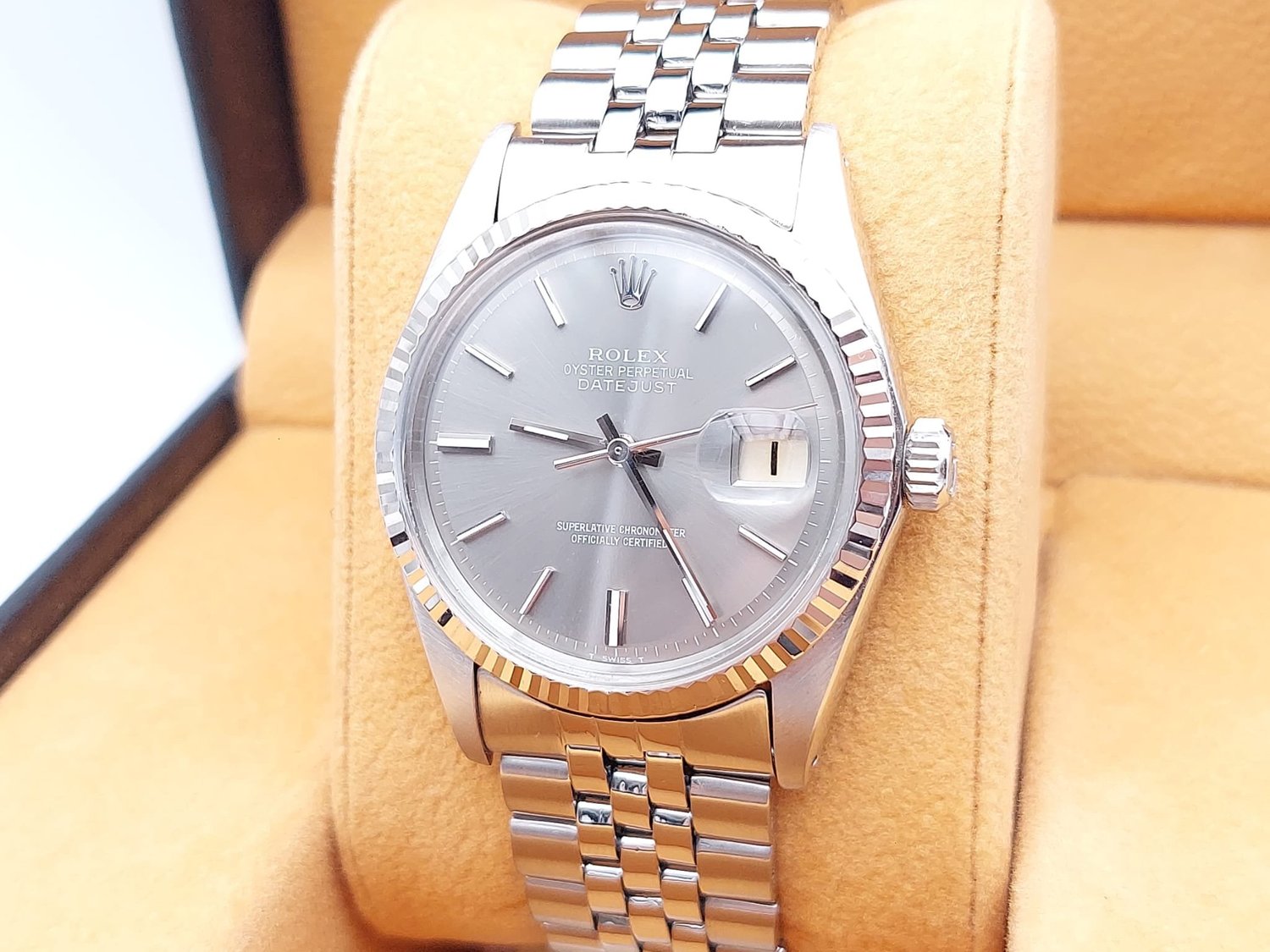
Since roughly 2005, Rolex laser-engraves 'ROLEX ROLEX ROLEX' around the rehaut — the inner ring between dial and crystal — with the serial number at 6 o'clock. On a genuine piece the letters are perfectly aligned with the minute markers and crisply cut. Fakes engrave the rehaut too now, but the alignment is usually sloppy and the lettering shallow or wavy. Tilt the watch under good light and look closely.
9. Serial and Model Numbers
On pre-2005 models, the serial is engraved between the lugs at 6 o'clock and the reference number at 12 (you'll need to remove the bracelet); newer watches put the serial on the rehaut. Genuine engravings are deep, sharp and precise — diamond-cut lines that catch light cleanly. Fake serials are typically acid-etched: faint, sandy and shallow. Cross-check the serial against Rolex production charts, and make sure the number on the papers matches the watch. A 'serial' that's been polished away or looks scratched in by hand is a five-alarm red flag.
10. The Crown and Winding Feel
Unscrew the crown. On a genuine Rolex it threads smoothly with a distinct, quality feel, and winding produces fine, even resistance with no grinding. The crown itself bears a crisp coronet with a dot or dash underneath indicating the Twinlock/Triplock system. Fakes often have rough threading, gritty winding, or a poorly stamped crown logo.
11. Bracelet and Clasp
Genuine Rolex bracelets are solid — no rattle, no flex, no gaps between links. The clasp closes with a precise, machined snap, and its engravings (coronet, 'Rolex' script, steel markings) are deep and clean. Shake the watch gently near your ear: rattly links are a classic fake tell. On modern models, check the Glidelock or Easylink micro-adjustment — it should glide with engineered resistance, not slop.
12. The Price and the Seller
No new Rolex sells for a fraction of retail, and no honest seller rushes you. A 'Submariner' at $2,000 from a marketplace listing with stock photos is not a deal — it's a replica with a receipt. Research the seller's history, demand the box and papers, and remember that paperwork can be faked too. If the deal pressures you to skip verification, the watch has already failed.
Red Flags That Should End the Conversation
- A price that's dramatically below market — genuine demand keeps Rolex prices high, and nobody sells a real one cheap.
- A display case back, a ticking seconds hand, or any engraving on the case back other than rare vintage exceptions.
- Spelling errors, misaligned text or a crooked coronet anywhere on the dial, clasp or crown.
- A seller who refuses a serial-number check, an in-person inspection, or an independent appraisal.
The Authentication Toolkit We Recommend
You don't need a watchmaker's bench to run the checks above — three inexpensive tools cover almost everything. A 10x jeweler's loupe reveals dial printing flaws and serial-etching quality that are invisible to the naked eye; it's the single highest-value tool in authentication.
A 0.1-gram digital pocket scale makes the weight test objective — compare against the published weight of the exact reference, and a watch that's 15–20 grams light has serious explaining to do.
A small UV flashlight rounds out the kit: modern Rolex dials and Chromalight lume react characteristically under UV, and it exposes aftermarket relumes, redialed dials and glue residue from swapped parts. Total outlay for all three tools is usually under $40 — cheap insurance on a five-figure purchase.
When to Pay for Professional Authentication
The checks above catch the vast majority of fakes, but top-tier super clones can pass all of them. For any purchase over a few thousand dollars, professional verification is worth the fee:
- An authorized Rolex dealer or Rolex service center can verify the watch and check its service history against the serial number.
- An independent certified watchmaker can open the case (with your permission) and inspect the movement — the one component fakes still can't fully replicate.
- Online authentication services with photographic review offer a fast, affordable second opinion before you commit.
Frequently Asked Questions
Can a fake Rolex pass all these checks?
The best super clones can pass most of them — which is why movement inspection by a professional remains the only 100% certain test for high-value pieces. For the $50–$500 fakes that make up the overwhelming majority of counterfeits, the checks above are decisive.
Does a real Rolex have a ticking or sweeping seconds hand?
Genuine modern Rolexes sweep at eight beats per second. A once-per-second tick means quartz, and Rolex hasn't made a quartz model since the discontinued Oysterquartz — which you'll essentially never encounter in the wild.
Is the serial number enough to authenticate a Rolex?
No. Serials are copied onto fakes all the time, and a real serial printed on paperwork doesn't prove the watch in front of you is the watch it was issued to. Use the serial as one check among twelve, never as sole proof.
The Bottom Line
Knowing how to tell if a Rolex is real comes down to checking the things counterfeiters can't afford to get right: weight, dial printing, Cyclops magnification, engraving quality and bracelet construction. Run the twelve checks with a loupe and a scale, walk away from any seller who resists inspection, and pay for professional authentication on anything expensive. The ten minutes you spend verifying is the difference between owning an asset and owning a very convincing paperweight.