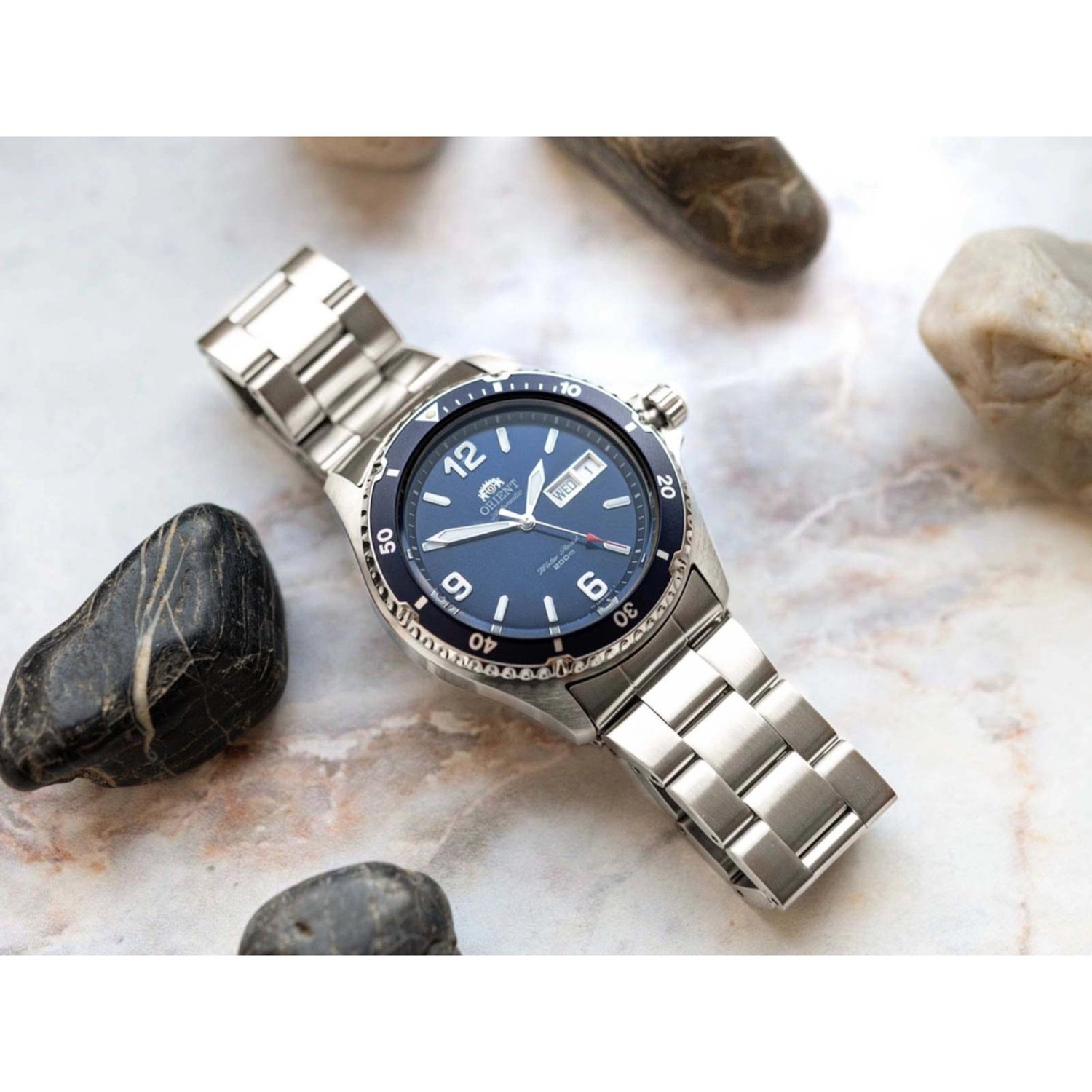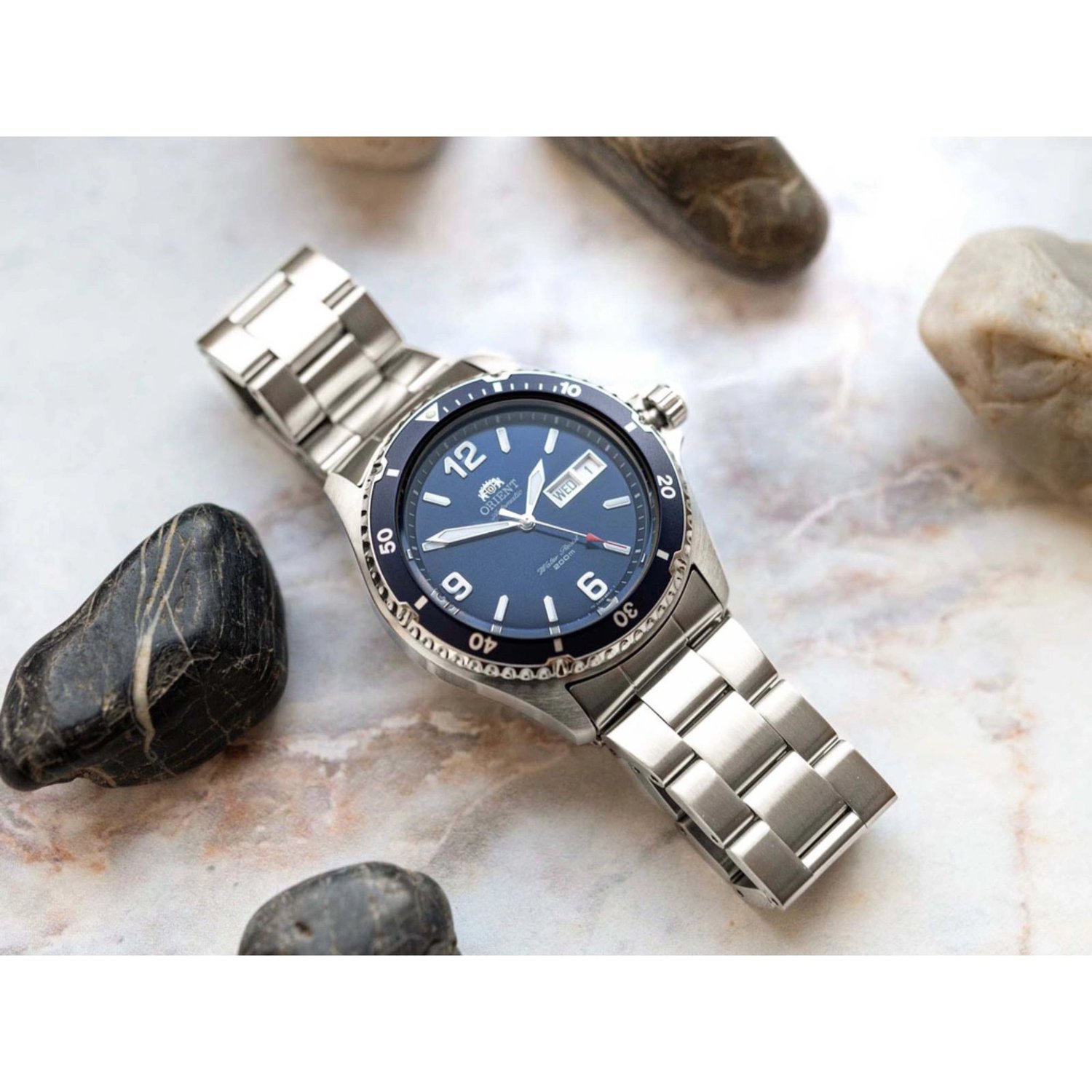
The Orient Ray II (ref. FAA02005D9) is the most honest diver under $200: 41.5mm of steel, a blue sunray dial with day-date at 3, a genuine 200m screw-down-crown rating, and Orient's in-house F6922 automatic with hacking and hand-winding — $305 at list, and $150-200 if you buy it the way we would. It's the descendant of the beloved Mako, with two visible cost cuts: mineral glass instead of sapphire, and a clasp that reminds you what you paid.
Maybe you want the sapphire the Ray II withheld, a bigger name, or the same dive effect for the price of takeout. These seven alternatives cover the brief from $50 up to — and well past — the Orient itself.
Why People Look for Ray II Alternatives
The Ray II's money buys three things rare under $200: an in-house Japanese automatic with hacking and hand-winding, a real 200m screw-down-crown platform, and Mako-line pedigree that predates most of its rivals. What it doesn't buy is sapphire — the crystal is mineral glass — or refinement: the bezel action and clasp are functional, not luxurious.
Others shop alternatives for direction: up, to the Kamasu sibling that fixes the crystal; sideways, to Seiko's iconic 5 Sports with the weaker water rating but the bigger hobby; or down, to the $50 legends that out-swim everything here.
What to Look For in an Alternative
- A real water rating — 200m with a screw-down crown if you actually swim or dive
- Sapphire crystal if you can stretch — the Ray II's mineral glass is its one honest weakness
- A movement with hacking and hand-winding — the F6922 has both; don't go backwards
- Case proportions near 41-42mm — the Ray fit flatters 7-inch wrists and up
- Pricing benchmarked to the Orient's $175-odd street reality, not its $305 list
The 7 Best Alternatives, Reviewed
1. Orient Kamasu
The in-brand answer: the same F6922 engine and 200m screw-down platform, plus a sapphire crystal, applied indices and sharper bezel execution — $220-280 real. If the mineral glass was your only hesitation, this is the same watch in better shoes; if it's the budget, read on.
2. Seiko 5 Sports SRPD55
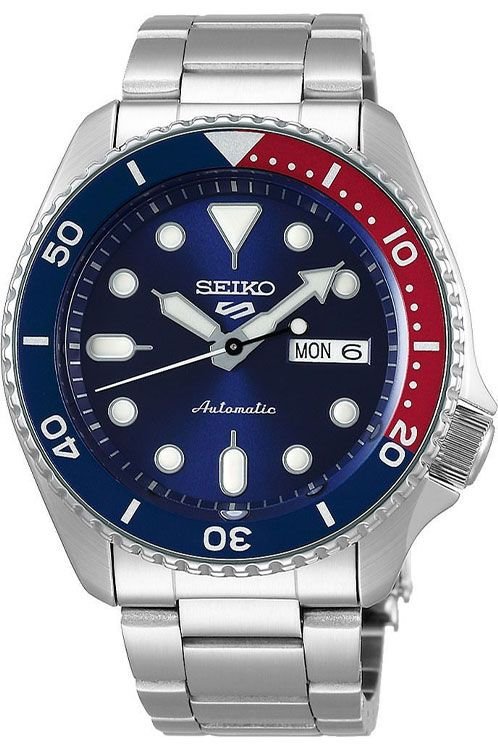
The Seiko rival: the iconic 4 o'clock crown case, the 4R36 with hacking and hand-winding, and the biggest modding ecosystem in watches — $200-275 real. Trades the Orient's 200m and screw-down crown for 100m and Hardlex; you pick the Seiko for the brand, the bracelet and the hobby, not the spec sheet.
3. Citizen Promaster BN0151
The solar answer: an ISO 6425-certified 200m diver with Citizen's Eco-Drive — light-powered, so it never needs a battery or a winding ritual — $230-300 real. Bigger at 44mm and quartz at heart, but the only watch here with paperwork a dive instructor respects.
4. Vostok Amphibia 420
The cult classic: a Russian 200m diver with an in-house automatic and a case design unchanged since the Cold War — $85-120 real. Quirky crown, crude finishing, and more genuine dive history than everything else on this list combined; buy it for the story, keep it for the bezel.
5. Casio Duro MDV106
The honest floor: a genuine 200m screw-down-crown diver with a marlin on the dial — $45-70 real. Quartz, mineral glass, and a price that rounds to nothing — yet it was famously worn by Bill Gates, and it will out-swim every watch above it on this list.
6. Invicta Pro Diver 1953
The retro option: a 1950s-styled diver with a Seiko-made NH35 automatic, gilt dial and 200m rating — $65-100 real against a theatrical $795 anchor price. Ignore the list-price theater completely; at street price it's a genuinely fun vintage-look mechanical.
7. Tissot Seastar 1000 Powermatic 80
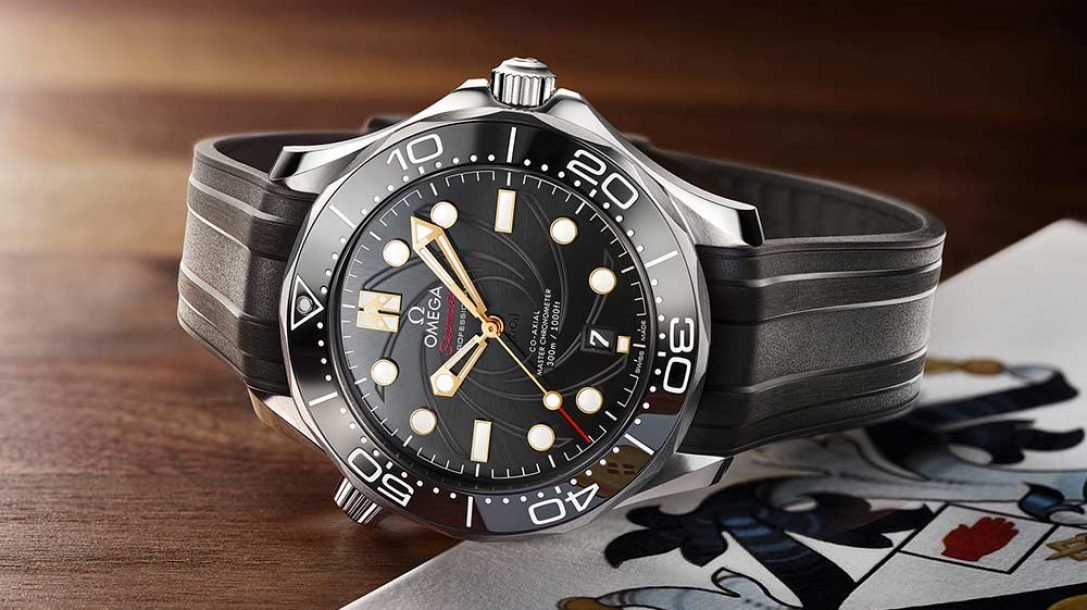
The Swiss step: 300m, ceramic bezel, sapphire and the 80-hour Powermatic 80 with a Swiss name on the dial — $500-700 real. Four times the Orient's money buys spec-sheet dominance and Swatch Group service backing; the choice for buyers who equate Swiss with serious.
How the Picks Compare
Sapphire sibling: Kamasu. Icon rival: SRPD55. Solar ISO: Promaster. Cult floor: Amphibia. Absolute floor: Duro. Retro fun: Pro Diver 1953. Swiss step: Seastar. The Ray II's moat is the combination nobody else quite matches at the money: an in-house hacking automatic plus a genuine 200m screw-down platform under $200. Fix the crystal for $70 more with the Kamasu, or save $100 with the Duro — everything else is a lateral move.
Frequently Asked Questions
Ray II or Kamasu?
Same engine, same 200m platform — the Kamasu adds sapphire, applied indices and sharper finishing for roughly $70 more. If you keep watches for years, the sapphire alone justifies the stretch; if you rotate beaters, save the money and the Ray II loses nothing important.
What's the cheapest credible Ray II alternative?
The Casio Duro at $45-70: real 200m, screw-down crown, quartz reliability. For mechanical at the floor, the Vostok Amphibia at $85-120 is the cult answer — crude, charming and nearly unkillable.
Is the mineral crystal a deal-breaker?
No — but it's the spec that shows the price. Mineral glass scratches where sapphire shrugs off decades. If you're hard on watches, budget the Kamasu instead; if you're careful, the Ray II's crystal will outlast your interest in the watch.
Will the Ray II hold its value?
Expect the standard affordable-diver curve: a drop from the $305 list to the $150-200 street reality, then a long flat line. Buy at street price and the depreciation has already happened to someone else.
The Verdict
The Ray II is the watch this list keeps failing to out-balance at the money — the Kamasu out-glasses it, the SRPD55 out-brands it, the Promaster out-papers it, and the Duro out-prices it. What none of them do under $200 is combine an in-house hacking automatic with a genuine 200m screw-down platform in a case that flatters real wrists. If you want one honest diver to beat on for a decade, buy the Orient at street price, put it on a NATO, and stop shopping; if sapphire matters, the Kamasu was always the same watch in better shoes.