Disclosure: The Watch Goat is reader-supported. When you buy through links on our site, we may earn an affiliate commission at no extra cost to you.
How Much Gold Is in a Rolex? Grams, Karats & Real Melt Value (2026)
Gold is half the reason a gold Rolex costs what it does — and almost none of the reason it's worth what it's worth. That distinction trips up buyers, inheritors and sellers every day: someone weighs a Day-Date on a kitchen scale, multiplies by the spot price, and ends up either insulted by a dealer's offer or convinced their two-tone Datejust is a piggy bank. This guide gives you the real numbers: how much gold is actually in a Rolex by type, how to run the melt-value math yourself, and why the metal is only the floor under a much bigger price.
How Much Gold Is in a Rolex? The Short Answer
It depends entirely on which Rolex you mean. A solid-gold model — Day-Date, gold GMT-Master II, gold Daytona — carries roughly 100–130 grams of 18k gold in its case and bracelet, which works out to about 75–100 grams of pure gold. A two-tone Rolesor model carries perhaps 10–15 grams of 18k gold. A stainless steel Rolex carries none at all. The spread between those answers is the entire ballgame.
✔ Solid 18k gold models: ~100–130g of 18k gold (case + bracelet) ≈ 75–100g pure gold — several thousand dollars of metal at typical spot prices.
✔ Two-tone Rolesor (steel + gold): ~10–15g of 18k gold ≈ 8–11g pure — a few hundred dollars of metal, not a few thousand.
✔ Steel, gold-capped or plated pieces: no meaningful gold content. Vintage 'gold shell' is a thick layer, not a solid case.
📌 Key Takeaway: Rolex uses only 18k gold (75% pure), and only in solid form on modern watches. The gold in a full-gold Rolex is worth thousands; the gold in a two-tone is worth hundreds. Never confuse the two when pricing one.
Rolex Only Uses 18k Gold — From Its Own Foundry
Rolex is one of the very few watchmakers that casts its own gold in-house, at its Plan-les-Ouates foundry in Geneva. Every gold Rolex — yellow, white or Everose — is 18 karat, meaning 75% pure gold alloyed with 25% other metals: copper and silver for yellow gold, palladium-forward mixes for white gold, and a proprietary copper-platinum blend for Everose, Rolex's fade-resistant take on rose gold. There is no 14k, no 10k, and on the modern catalog, no plating of any kind.
That last point matters when you're evaluating a watch: if a modern 'Rolex' is described as gold-plated or gold-tone, it isn't a Rolex. Genuine gold components carry hallmarks — the '18k' or '750' stamp, plus the Swiss St. Bernard dog hallmark on older pieces and the Swiss head-of-a-dog ('tête de chien') precious-metal mark on newer ones — found inside the caseback, on the clasp, or between the lugs.
How Much Gold Is in a Solid-Gold Rolex?
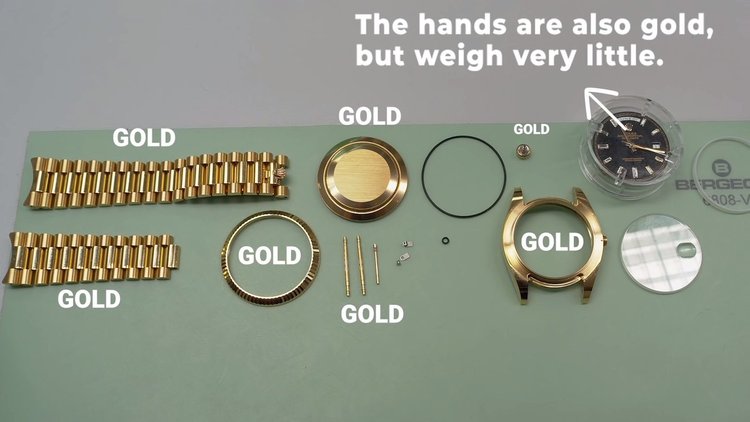
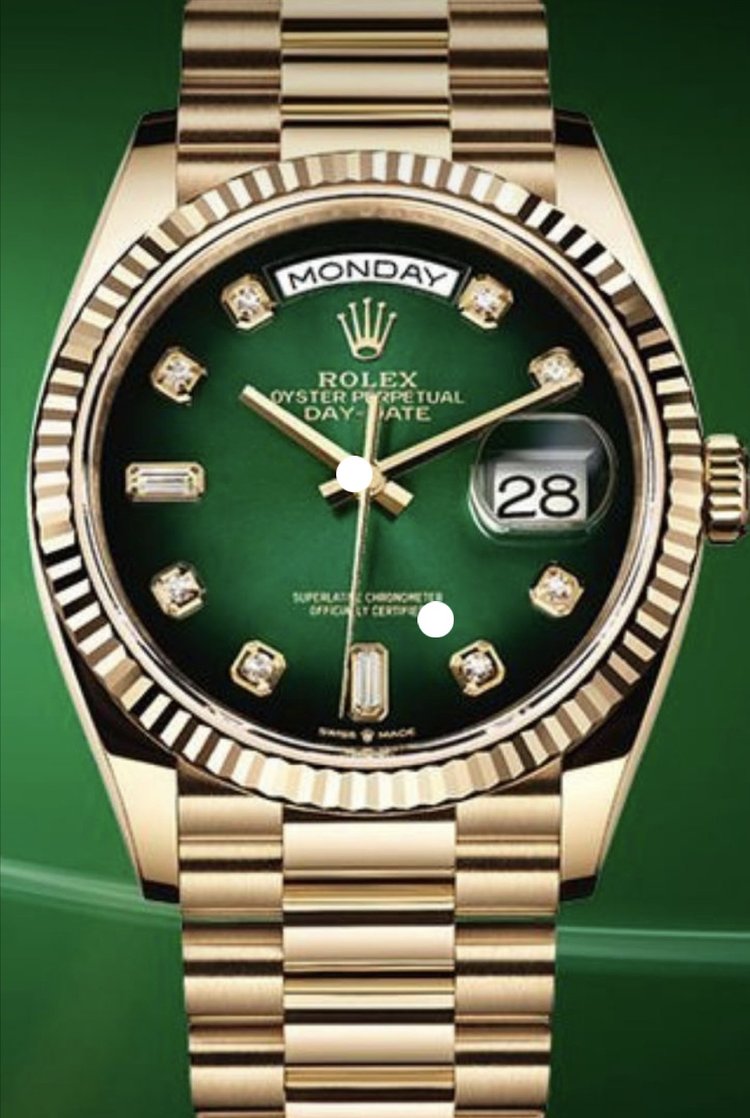
Take the reference case: a current Day-Date 36 in 18k yellow gold on a President bracelet weighs roughly 140–170 grams all-in. Subtract the movement (~30–40g), the sapphire crystal, dial, spring bars and sundries, and you're left with approximately 100–130 grams of 18k gold in the case, bezel, crown and bracelet. At 75% purity, that's about 75–100 grams of pure gold. A Day-Date 40 or a full-gold GMT-Master II runs heavier still; smaller vintage 34mm gold models run lighter.
The melt math is simple once you have the pure-gold figure: divide grams by 31.1035 (grams per troy ounce) and multiply by spot. Illustrative example: 85 grams of pure gold at a $2,600/oz spot price works out to roughly $7,100 in metal value. Scale the example to whatever spot is doing when you read this — the formula doesn't change.
How Much Gold Is in a Two-Tone (Rolesor) Rolex?
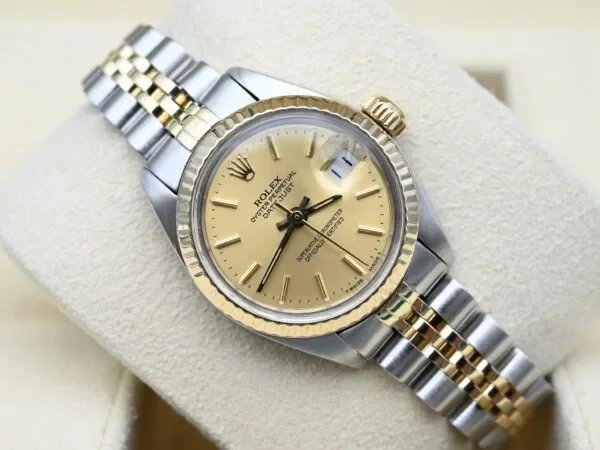
Rolesor is Rolex's term for steel-and-gold combinations, and it's where the most expensive misunderstandings happen. On a two-tone Datejust or Submariner, the gold is limited to the fluted bezel, the winding crown and the bracelet's center links (plus hands and indices). Add it up and you get roughly 10–15 grams of 18k gold — about 8–11 grams of pure gold, or a few hundred dollars of metal.
So when a seller leans on 'it's a gold Rolex' for a two-tone, be polite and be skeptical. The gold premium in a Rolesor watch is real — they cost more than steel equivalents — but it's a design and desirability premium, not a bullion position. The metal alone will never bail you out.
Gold-Capped, Gold Shell and Plated: The Vintage Exceptions
Dig into vintage and the picture gets murkier. Mid-century 'golden Egg' and US-market Rolex pieces were sometimes gold-capped or 'gold shell' — a thick sheet of gold bonded over a base-metal or steel core, thicker than plating but nowhere near solid. Other brands used heavy gold electroplate (HGE) measured in microns. These watches have some gold, but recovery is uneconomical: a refiner's fee exceeds the metal's worth. Value them as watches, on condition and rarity — never as metal.
Melt Value vs Market Value: Why Melt Is a Floor, Not a Price
Here's the crucial framing: melt value is what the watch is worth if everything that makes it a Rolex is destroyed. A full-gold Day-Date trading at $30,000–$40,000 contains perhaps $6,000–$9,000 of gold at typical spot prices — meaning the metal is 20–30% of the market price, and the remaining 70–80% is the manufacture, the movement, the brand and the demand. Nobody sane melts a running Day-Date, which is precisely why dealers who quote you 'melt minus refining' for one are lowballing you.
The floor matters in exactly two scenarios. First, it puts a hard bottom under full-gold models: even in a demand collapse, the metal is worth thousands, which is one reason gold Rolexes hold value better than steel-hyped references over long windows. Second, it exposes overpriced two-tones and 'gold' fakes — if the pitch leans on gold content, run the grams before you run for your wallet. For current market pricing on gold models, see our gold Rolex value guide.
How to Estimate the Gold in Your Rolex
- Weigh the complete watch on a gram-accurate scale — case, bracelet, everything.
- Subtract the non-gold parts: figure roughly 30–40g for the movement and a few grams for crystal and dial on a full-gold model.
- Multiply the remainder by 0.75 (18k = 75% pure) to get pure-gold grams.
- Divide by 31.1035 and multiply by the current spot price per troy ounce — that's your melt floor.
Two warnings. Dealers and refiners pay under melt (typically 90–98% for clean gold), and an online 'we buy gold' scale photo is not an appraisal. And never, ever sell a running Rolex for melt: any full-gold model in decent condition is worth substantially more intact. If you're sitting on one, get offers from proper watch buyers, not gold buyers.
Is Rolex Made of Real Gold?
Yes — every gold Rolex is solid 18k gold, cast in Rolex's own Geneva foundry. There is no plating, filling or vermeil anywhere in the modern catalog: gold cases, bezels, crowns and bracelets are solid alloy all the way through, which is why a gold Rolex can be polished for decades without wearing through to a base metal. The '750' and Swiss hallmark stamps inside the caseback and on the clasp are the proof.
How Much Gold Is in a Two-Tone Rolex?
About 10–15 grams of 18k gold — the fluted bezel, crown, bracelet center links and dial furniture — which is roughly 8–11 grams of pure gold, worth a few hundred dollars at typical spot prices. Rolex doesn't publish per-model gold weights, so treat this as an informed estimate, not a spec. For the flagship full-gold breakdown, see our Rolex President gold breakdown.
Gold Looks on a Budget: Our Favorite Gold-Tone Picks on Amazon
Bulova Classic Gold-Tone
A genuine heritage brand doing the gold dress watch honestly — reliable quartz or automatic options, real warranties, and prices that regularly dip under $200. The thinking person's gold-look daily.
Citizen Eco-Drive Gold-Tone
Eco-Drive solar charging means this one runs for a decade with zero battery changes. A maintenance-free gold-tone watch for weddings, offices and gifting.
Tissot Gold PVD (T-Classic)
Swiss Made with Tissot's build quality and PVD gold finishing that outlasts cheap plating — the closest thing to gold-Rolex presence under $500.
The Verdict
How much gold is in a Rolex? In a full-gold model, roughly 75–100 grams of pure 18k gold — thousands of dollars of metal, and still only a fraction of the watch's market value. In a two-tone, about 10 grams — hundreds of dollars, full stop. The gold sets the floor; the Rolex sets the price. Weigh honestly, calculate calmly, and value the watch as a watch.