Disclosure: The Watch Goat is reader-supported. When you buy through links on this page, we may earn an affiliate commission from Amazon at no extra cost to you. Prices and availability change — check the listing for the current price.
The Rolex Day-Date — known everywhere as the Rolex President — has been the brand's flagship since 1956, and Rolex has never sold it in anything but solid precious metal. That makes the question more interesting than it first sounds: how much gold is actually in a Rolex President, what is that metal worth on its own, and why does the watch command so much more than its melt value? Here are the real numbers, by reference, plus what to do if you want the look without the five-figure buy-in.
The Short Answer: Roughly 75–120 Grams of Pure Gold
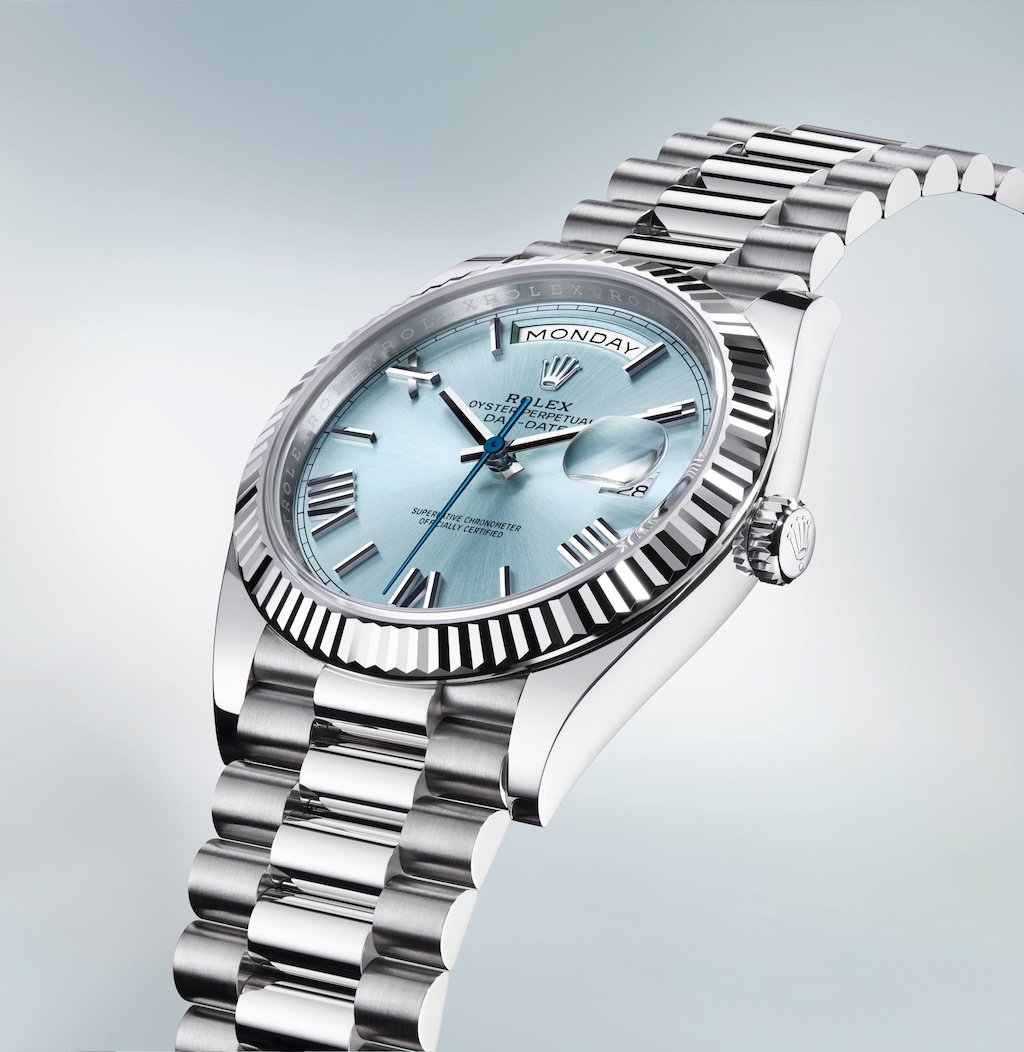
A modern solid-gold Rolex President contains approximately 75 to 120 grams of pure gold, depending on the reference. The Day-Date 36 works out to roughly 75–85 grams of pure 18k gold; the larger Day-Date 40 to roughly 100–115 grams. Those figures account for the case, bezel, crown and full President bracelet — but not the movement, crystal or dial, which contain no meaningful gold. Two-tone Presidents effectively do not exist (more on that below), and platinum Day-Dates swap gold entirely for a heavier precious metal.
Every President Is Precious Metal — That's the Point
Rolex has only ever produced the Day-Date in 18k gold — yellow, white or Everose rose — and in platinum. There has never been a stainless steel Day-Date, which is precisely why the President sits above the Datejust in the lineup: it was engineered from day one as the watch you buy when steel is no longer the statement you want to make. If gold content across the wider catalog interests you, our breakdown of how much gold is in a Rolex covers every model line.
The President nickname itself comes from the three-link President bracelet, designed for the Day-Date's launch and never offered on any other model. Lyndon B. Johnson wore one in the White House, and Rolex's own advertising leaned into the association — 'the watch of presidents' — until the name stuck permanently.
Gold Content by Reference
- Day-Date 36 (refs 18038, 18238, 118238, 128238): total watch weight around 140–150 g; the 18k gold alloy in case, bezel, crown and bracelet is roughly 100–110 g, which at 75% purity means about 75–85 g of pure gold.
- Day-Date 40 (ref 228238 and siblings): total weight around 205–210 g; gold alloy roughly 135–155 g, putting pure gold content around 100–115 g.
- Vintage Day-Date (refs 1803, 6611 and early variants): lighter bracelets and smaller cases mean roughly 65–80 g of pure gold — and many surviving examples have lost metal to decades of polishing.
- The two-tone myth: if a 'President' has any steel in it, it is not a Day-Date — it is a Datejust on a different bracelet. There is no Rolesor Day-Date, which is one of the fastest authenticity checks available; our guide to what a President costs today has more.
What 18k Actually Means
Rolex uses 18 karat gold for every gold Day-Date: 75% pure gold alloyed with copper, silver and — in Everose's case — a touch of platinum to lock in the rose color. Rolex runs its own foundry in Geneva and casts its own alloys, which is part of why the gold holds its color for decades where plated watches fade. The 75% figure is the one that matters for any melt calculation: multiply total gold-alloy weight by 0.75 to get pure gold content.
Melt Value vs. Market Value
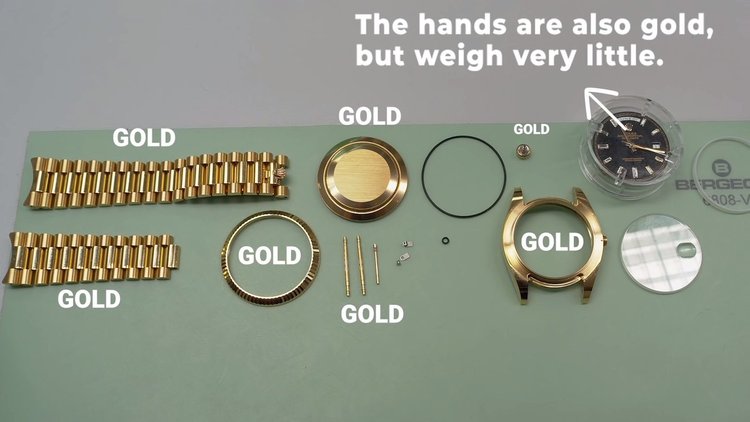
The melt math is simple: pure gold grams multiplied by the current spot price per gram. For illustration, at a hypothetical $110 per gram, a Day-Date 40's roughly 100–115 g of pure gold works out to $11,000–12,650 in metal alone. Gold prices move daily, so always pull the current spot price before doing this calculation for a real watch.
Here is the part that surprises people: the metal is the floor, not the price. A new yellow-gold Day-Date 40 retails well into the $40,000s, and clean pre-owned Day-Date 36 references start around the mid-teens — two to four times melt value. You are paying for the movement, the manufacture, the brand and the resale liquidity that comes with it. Scrapping a running Day-Date for its gold would be lighting money on fire; if you want President-level presence without the premium, our Day-Date 40 alternatives guide is the honest shortcut.
The President Look for Less: Our Picks
Maybe the five-figure President is the goal for later. If it is the warm gold look you want today, these three deliver it honestly — check each listing for the current price.
Citizen Gold-Tone Dress Watch — the Everyday Answer
Citizen's gold-tone Eco-Drive dress watches give you the champagne-dial President silhouette with solar charging that never needs a battery. The finishing punches above the price, and the slim case wears the way a Day-Date 36 does — present, not loud. The honest budget route into gold-watch dressing.
Seiko Gold-Tone Dress Watch — the Classic Route
Seiko's gold-tone dress line — fluted-style bezels, day-date complications, jubilee-ish bracelets — is the closest mainstream answer to the President formula. Japanese quartz reliability, real water resistance, and a look that reads deliberate rather than costume. The day-date window at three o'clock is the tell that Seiko knew exactly which watch it was answering.
Bulova Gold-Tone — the Retro Statement
Bulova's gold-tone dress and vintage-reissue models lean into the warm-metal seventies aesthetic that modern Presidents echo. Better finishing than the price suggests, an American brand with genuine history, and designs that look intentionally retro rather than imitative. The pick for buyers who want character with their gold tone.
Frequently Asked Questions
How much gold is in a Rolex President?
Approximately 75–85 grams of pure 18k gold in a Day-Date 36 and 100–115 grams in a Day-Date 40, counting the case, bezel, crown and President bracelet. The movement, dial and crystal contribute nothing. Vintage references run lighter, around 65–80 grams.
Is the Rolex President solid gold or plated?
Solid 18k gold, always. Rolex has never made a plated, gold-capped or steel Day-Date — every President ever produced is solid 18k yellow, white or Everose gold, or platinum. A 'President' showing steel anywhere is either a Datejust or worse.
Is a Rolex President worth its gold weight?
It is worth far more. Melt value is roughly a quarter to a half of market value depending on the reference and the gold price, because you are buying the movement, the finishing and the most liquid luxury watch brand on earth. Gold content is the value floor, never the ceiling.
Can you buy a two-tone Day-Date?
No. Rolex reserves two-tone Rolesor construction for the Datejust and other lines; the Day-Date has always been single-alloy precious metal only. Any two-tone 'President' is a Datejust with a bracelet swap — priced accordingly.
The Bottom Line
A solid-gold Rolex President carries 75–120 grams of pure 18k gold — real intrinsic value, but only a fraction of what the watch is actually worth. Buy one for the movement, the history and the liquidity, not the melt math. And if this guide answered your question, our companion piece on how much gold is in a Rolex Presidential covers the sibling references in the same detail.