Disclosure: The Watch Goat is reader-supported. When you buy through links on this page, we may earn an affiliate commission from Amazon at no extra cost to you. Prices and availability change — check the listing for the current price.
Lab-grown diamonds are not fake diamonds — they're the same carbon crystal, grown in a reactor instead of mined, indistinguishable without lab equipment and roughly half the price. For watches, that math is transformative: bezels and dials that would add thousands in mined stones add hundreds in lab-grown, with certification to match.
The category is still young, so the field splits between watch brands adopting lab-grown stones, jewelers setting them onto established watches, and custom shops building to order. Here are the seven smartest ways to buy a lab-grown diamond watch in 2026 — and the paperwork that separates real value from marketing.
1. Fashion Brands with Disclosed Lab-Grown Accents — the Under-$300 Entry
A growing number of affordable watch brands now use lab-grown diamond markers and disclose them plainly. You get genuine-stone bragging rights on a quartz fashion watch without the mined-stone premium.
- Why we like it: Real lab-grown diamonds at fashion prices
- Keep in mind: Small accent stones — this is subtle, not pavé
2. Lab-Grown Diamond Bezel Conversions on a Seiko or Citizen Base — the Enthusiast Hack
Custom setters will replace a stock bezel with a lab-grown pavé ring on a robust automatic diver or everyday watch. The result: a genuine diamond bezel on a movement that will outlive the trend.
- Why we like it: Genuine stones on a workhorse watch, uniquely yours
- Keep in mind: Aftermarket work — choose the setter carefully and expect no brand warranty on the modification
3. Jewelry-Brand Lab-Grown Tennis-Style Watches — the Bracelet Crossover
Several lab-grown diamond jewelry brands now pair their tennis-bracelet expertise with quartz watch heads. It wears like jewelry that happens to tell time, with certified stones throughout.
- Why we like it: Certified lab-grown stones, fine-jewelry finishing
- Keep in mind: The watch itself is basic quartz — you're paying for the stones
4. Independent Microbrands with Lab-Grown Dials — the Design-Forward Pick
Small watch brands are setting lab-grown markers into original dial designs at $500–1,500 — real watchmaking identity with honest stones and honest specs, usually with sapphire and automatic movements.
- Why we like it: Original designs, proper specs, certified stones
- Keep in mind: Microbrand resale is thin — buy to keep
5. Swiss Fashion-Swiss with Lab-Grown Options — the Middle Tier
Some established fashion-Swiss names have begun offering lab-grown diamond variants of their best-sellers, bringing boutique build quality and brand service to the category.
- Why we like it: Brand backing, service network, documented stones
- Keep in mind: Premium over no-name equivalents — you're buying the logo too
6. Custom Lab-Grown Iced-Out Builds — the Statement Tier
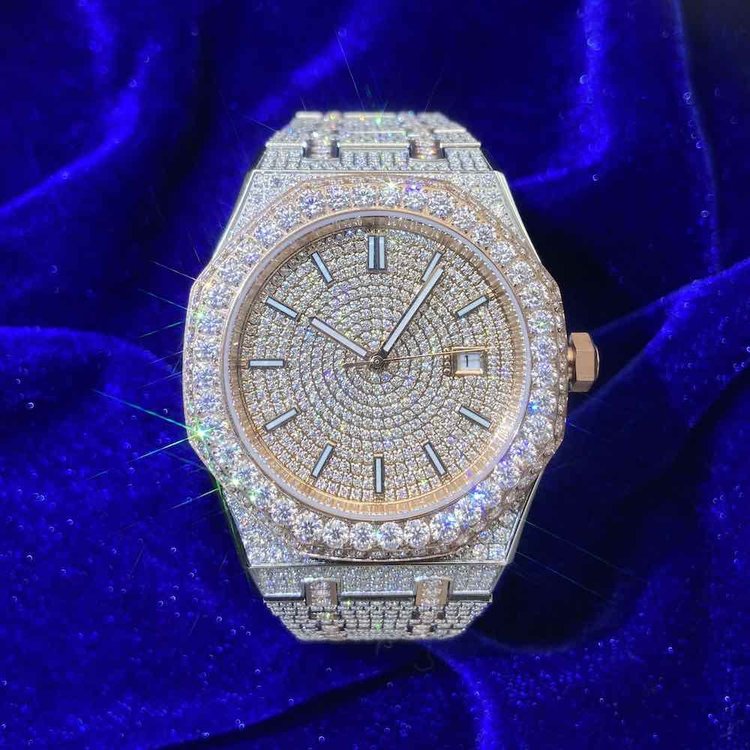
Full pavé lab-grown custom jobs deliver the iced-out look at a fraction of mined-stone pricing: entire bezels, dials, and bracelets in certified lab-grown stones on the base watch of your choice.
- Why we like it: Maximum stones per dollar, fully documented
- Keep in mind: Aftermarket ice kills brand resale — this is a wear-it-forever purchase
7. Pre-Owned Lab-Grown Pieces — the Value Double-Dip
As early adopters sell, certified lab-grown watches are appearing pre-owned at another discount off the already-lower new price. Verify the certificate matches the watch and the savings compound.
- Why we like it: The cheapest route into certified lab-grown stones
- Keep in mind: Thin market — patience required
Lab-Grown vs Mined: What's Actually Different
Chemically and optically: nothing. A lab-grown diamond scores 10 on Mohs, throws the same fire, and passes a standard diamond tester. The differences are origin, price (roughly 40–60% less), and resale — mined stones currently hold value better, though both depreciate from retail. For a watch you'll wear rather than resell, lab-grown is simply more stone for the money.
- Insist on certification from a recognized lab for anything marketed as lab-grown diamond
- 'Lab diamond' and 'moissanite' are different stones — moissanite is cheaper and doubly refractive
- Lab-grown should cost noticeably less than an equivalent mined-stone piece — if it doesn't, walk
What to Check Before You Buy
Certificate first: the stone documentation should name lab-grown diamond explicitly. Then the watch itself — movement, crystal, water resistance — because stones on a disposable case are still on a disposable case. Finally, ask who set the stones and what warranty covers the setting work.
Frequently Asked Questions
Is a lab-grown diamond a real diamond?
Yes. Lab-grown diamonds have the same chemical composition, hardness, and optical properties as mined diamonds — even gem labs need specialized equipment to tell them apart. They are not cubic zirconia or moissanite.
Do lab-grown diamond watches hold value?
Like most gemstone jewelry, they depreciate from retail — currently more steeply than mined-stone pieces. Buy a lab-grown diamond watch to wear and enjoy, not as an investment.
Will a diamond tester confirm lab-grown stones?
Standard diamond testers read lab-grown diamond as diamond, because it is one. Distinguishing lab-grown from mined requires laboratory spectroscopy — which is why certification documents matter.
Why are some 'lab diamond' listings suspiciously cheap?
Because some sellers use 'lab diamond' loosely to mean moissanite or CZ. Genuine lab-grown diamond costs real money — a full pavé watch at $99 is not lab-grown diamond, whatever the title says.
Final Verdict
Lab-grown is the honest way to get real diamonds without mined-stone pricing — the sweet spot is certified stones on a watch with real specs, from a brand or setter who documents everything. If budget is tighter, our moissanite watch guide covers the next step down, and the genuine diamond watch roundup maps the mined-stone route at every tier.